42% Urea Cream for Cracked Heels: How High-Strength Urea Supports Softer Skin
Share
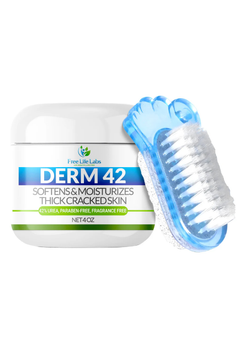
Dry, cracked heels are more than a cosmetic annoyance. Thick, fissured skin can catch on sheets, sting during walking, and make basic foot hygiene harder—especially for people who stand all day, walk in open-back shoes, or live in arid climates. One of the most clinician-familiar topical tools for this problem is high-strength urea cream, including maximum-strength options around 42% urea such as Derm 42.
This guide explains what urea does on the skin, why 42% is considered “maximum strength” in many OTC foot-care contexts, how to use it, how it compares with lower-strength lotions, and when to involve a podiatrist or other clinician.
What urea does for dry, cracked skin
Urea is a natural component of the skin’s natural moisturizing factor (NMF). In creams and lotions, it acts as a humectant (attracts and holds water) and, at higher concentrations, as a keratolytic helper that softens hardened, hyperkeratotic skin so moisture can penetrate more effectively.
Think of a cracked heel as a flexible hinge that has turned into cardboard. Water alone is not enough if the outer keratin layer is rigid; you need an ingredient that softens that layer while helping water stay put. Urea is unusually good at both jobs, which is why it appears so often in podiatry-adjacent moisturizers.
Concentration roughly maps to intent:
- Lower percentages (often ~5–10%) — daily moisturizing support for mild dryness
- Mid-range (~10–25%) — more stubborn dryness and rough texture
- High-strength (including ~40–42%) — very dry, thickened, cracked heel skin under typical foot-care use
Dermatology and podiatry education frequently discusses urea as a workhorse ingredient for xerosis (abnormally dry skin) and heel fissure care when used appropriately.
Why people seek 42% urea specifically
When heels are thick, yellowed, and fissured, gentle drugstore lotions often evaporate before they change texture. Higher urea percentages are chosen because they more aggressively soften the stratum corneum—the outer layer that has become rigid.
That softening effect is why products like Derm 42 are positioned for maximum-strength moisturizing support for rough, cracked feet—not as a perfume lotion. Pairing urea with occlusive and emollient ingredients (such as shea butter in some formulas) helps seal in hydration after the keratolytic work begins.
People often arrive at 42% after a familiar pattern: lotion for months → still cracked → pumice overuse → more irritation → clinician recommends a high-urea cream and better footwear habits together.
How to apply 42% urea cream on cracked heels
General consumer guidance (always defer to your clinician and the product label):
- Wash feet with mild soap and lukewarm water; pat dry thoroughly—especially between toes.
- Apply a thin layer of cream to heels and other rough areas; a little high-strength urea goes a long way.
- Use once or twice daily consistently for several weeks rather than sporadically.
- Wear cotton socks after evening application if your clinician suggests light occlusion to boost hydration.
- File gently with a pumice stone only on intact, softened skin if recommended—never on bleeding fissures or infected areas.
- Reassess at two to four weeks; stubborn fissures may need in-office care.
Avoid getting high-strength urea into the eyes or on mucous membranes. Discontinue and seek care if burning, rash, or irritation is severe.
Comparing urea with other heel remedies
| Approach | Role | Limitation |
|---|---|---|
| Basic lotion | Light daily moisture | May not soften thick keratin |
| Petroleum jelly | Occlusion / seal | Little keratolytic action alone |
| Pumice / filing | Mechanical thinning | Risky if sensation is reduced |
| High-urea cream | Soften + hydrate | Needs consistency; not for open ulcers without guidance |
| Professional debridement | Targeted callus care | Requires clinician |
Often the winning combo is high-urea moisturization + smart footwear + professional care when needed—not any single product in isolation.
Safety caveats — especially with diabetes or poor circulation
People with diabetes, neuropathy, or peripheral artery disease should treat foot skin changes as a clinical issue, not a DIY cosmetics project. Deep cracks can become entry points for infection. High-strength creams may still be appropriate—but under clinician guidance, with regular foot checks.
Do not use urea cream as a substitute for medical evaluation of ulcers, spreading redness, fever, drainage, or blackened tissue. Those require urgent care.
If you cannot see or reach your feet, ask a partner for help or schedule more frequent podiatry visits. Vision impairment is a common reason heel cracks are discovered late.
What results to expect (realistic timeline)
Many users notice softer-feeling skin within days to a couple of weeks of consistent use, with more visible improvement in heel texture over several weeks. Outcomes vary with climate, footwear, bathing habits, age, and underlying medical factors.
Urea cream moisturizes and softens; it does not “cure” systemic causes of dry skin such as thyroid disease, medication effects, or environmental extremes. Keep expectations aligned with cosmetic comfort and barrier support.
Lifestyle habits that multiply topical results
- Choose shoes with a closed heel counter that reduce shear on the fat pad
- Avoid ultra-hot showers that strip lipids
- Moisturize within three minutes after bathing when possible
- Stay hydrated and address indoor humidity in winter
- Manage callus care with a professional if you cannot see or reach your feet safely
- Replace worn footwear that collapses at the heel
Standing occupations (healthcare, retail, warehouses) may need scheduled cream application the way athletes schedule recovery work—non-negotiable rather than optional.
Where Derm 42 fits
Derm 42 Skin Care is Free Life Labs’ maximum-strength 42% urea cream designed for dry, cracked, rough skin—commonly heels and feet. It is part of a clinician-familiar catalog that also includes nerve and wound-support products for practices that manage lower-extremity concerns comprehensively.
Explore the Derm 42 collection for product details, and ask your podiatrist or primary clinician whether high-strength urea belongs in your routine.
Related reading
- Diabetic foot care for dry, cracked heels
- Are calluses dangerous for diabetics?
- How to apply urea cream
Soft CTA
If cracked heels have outgrown basic lotion, talk with your provider about a 42% urea option and review Derm 42. Free Life Labs support: support@freelifelabs.com · 801-923-3878 (Boerne, TX).
Research & education themes
- Dermatologic reviews of urea as humectant/keratolytic across concentration ranges.
- Podiatry foot-care education on xerosis and heel fissure moisturization strategies.
- Diabetes foot-care principles emphasizing daily inspection and professional management of breaks in skin.
- Occupational and footwear factors contributing to plantar heel hyperkeratosis.